Explainer: the “yellow line” to which Israeli forces will withdraw in Gaza

الخامسة للأنباء - غزة
Since dawn Thursday, attention has focused on Israeli movements inside the Gaza Strip after the announcement of the start of the first phase of a military withdrawal, a step described as the beginning of implementing the Sharm El-Sheikh agreement to halt the war and exchange prisoners.
According to Israel’s official broadcasting corporation, three Israeli military units that had been fighting in Gaza City and refugee camps in the northern part of the Strip began an organized withdrawal from their positions, preparing to reposition according to what is known as the “yellow line” set out in the U.S. peace plan announced by President Donald Trump.
The map attached to the initial withdrawal plan showed that Rafah, Beit Hanoun and the Philadelphia axis will remain under Israeli control in this phase.
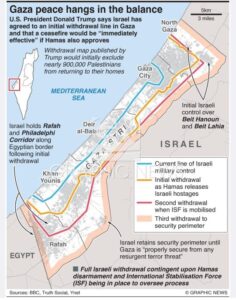
The “yellow line” shown on the map outlines the first phase of the U.S. plan announced by Trump last week, under which the Israeli army is expected to withdraw from northern Gaza to the outskirts of Rafah, coinciding with the implementation of a prisoner-and-returns-of-remains exchange.

Under the mapped route, the withdrawal begins from Beit Hanoun in the north, passing through Beit Lahia, Gaza City, al-Bureij, Deir al-Balah, Khan Yunis and Khaza’a, reaching Rafah in the south of the Strip. Thus it constitutes a gradual longitudinal withdrawal extending from north to south, traversing Gaza’s main population centers.

An Israeli army source told Reuters the first phase of the partial withdrawal would be completed within 24 hours, adding that the army “is preparing to move to adjusted deployment lines.” Israeli army radio said the three units deployed inside Gaza City had stopped advancing and that current operations “aim only to remove threats and secure the withdrawal route.” These movements follow Trump’s announcement early Thursday that Israel and Hamas had signed the first phase of a 20-point peace plan, which begins with the release of prisoners by both sides and a ceasefire. While the Israeli government is expected to formally ratify the agreement within hours, Israeli Prime Minister Benjamin Netanyahu said he would hold a government meeting on Thursday to approve the declared agreement, which would end the war in Gaza, adding: “By approving the first phase of the plan, all the prisoners will be returned home.”